 Kashio Games
Craquelure クラクリュール/ˌkrækˈljʊər/
- 発表Year
- 2026
- 必要な道具You need
- コンピューターで遊ぶゲーム(盤と駒では遊びにくい)Played on a computer (hard to play with a physical board)
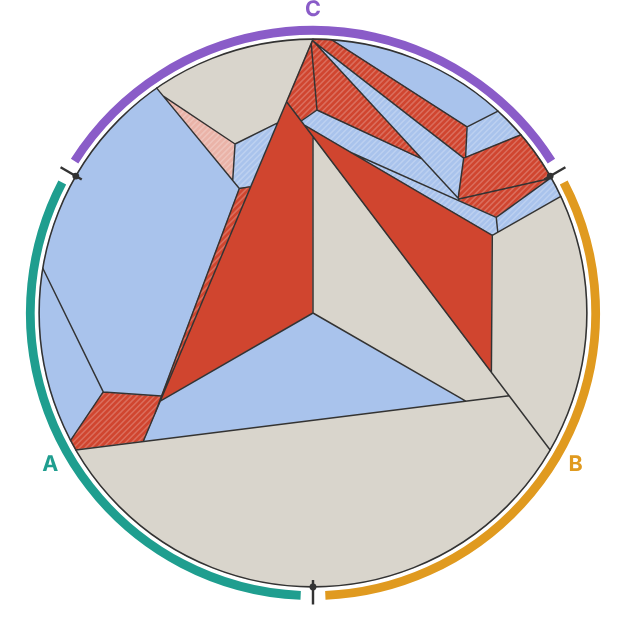
円盤を3本の線で分割していき、自分の色の領域で3本の弧をつなぐゲーム。手ごとに盤そのものが形を変えていく。
Cut a disk apart with three rays at a time and connect three arcs of its rim with your own regions. The board itself takes shape as you play.
ルールRules
コンポーネント
- 円盤1枚(コンピューター上で遊ぶことを想定しています)。円盤の半径は1で、中心を(0, 0)とする座標を使います。
定義
- 領域:線で区切られた円盤の一部分のことです。中立・青・赤のいずれかの色を持ちます。
- 片:1回の分割でできる3つの部分のそれぞれのことです。片はそのまま新しい領域になります。
- 確定した領域:もうどう割っても、3つの片すべてを最小面積以上にできない領域のことです。誰にも割れないので、色はゲームの終わりまで変わりません。中立の領域が確定すると、その手番の終わりに相手の色になります(手番を参照)。
- 目標の弧:円盤の外周を3つに分けた弧 A・B・C のことです。弧の境目は、外側の3つの領域それぞれの弧の真ん中にあります。
- グリッド:使いません。分割点は円盤の中のどの点でも選べ、座標は実数です。
- 向きの刻み:ありません。線の向きは実数の角度(度)で選べます。
- 最小面積:円盤の面積の0.5%です。面積は円盤全体に対する割合(%)で表します。
- デモでは、開始の形(風車・3つの扇形)、グリッドの形(四角形・三角形・なし)と細かさ(円盤の直径をグリッドの何目にするか)、向きの分割数(360の約数のうち3の倍数、または実数)と、3分割・6分割のときの開始の向き、最小面積(あり・なし、ありならその値)を設定で変えられます。上の値は標準の設定です。
終了条件
- 自分の色の領域を辺でつないで、3本の弧すべてに接したら勝利となります。
- どの手も相手に領域を渡すため、相手のつながりを完成させてしまうこともあります。その場合は相手の勝利です。両者が同時につながることはありません。
準備
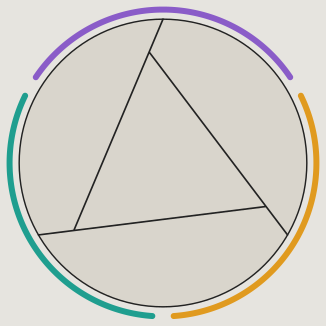
- 円盤を、3本の線で4つの中立の領域に分けた状態から始めます(風車の形)。3本の線は外周の120°おきの点(上・左下・右下)から内側へ伸び、中央に正三角形を残して互いに突き当たります。
- 中央の三角形と外側の3つの領域は、どれも円盤の面積のちょうど4分の1です。外側の領域はそれぞれ2本の弧に接し、中央の三角形はどの弧にも接していません。
- 自分の色を選択します。青が先手番です。
交代(パイルール)
- 青の最初の1手のあと、赤は一度だけ交代を選べます。交代すると、2人が持つ色を入れ替えます。盤面はそのままで、赤(最初の1手を指したプレイヤー)の手番になります。
- 交代しない場合は、赤はそのまま自分の手を指します。
- このルールのため、青は「強すぎて交代されてしまう」最初の1手を避け、交代されてもされなくても困らない手を探すことになります。
手番
- 中立の領域か、相手の色の領域を1つ選びます。自分の色の領域は割れません。
- その内側の1点から、120°ずつ開いた3本の線を領域の端まで引き、3つの片に分けます。点は領域の内側のどこでもかまいません(線の上は不可)。グリッドや向きの刻みを使う設定では、点と向きをそれにそろえます。
- 中立の領域を割った場合:1つを自分の色、1つを相手の色にし、残りの1つは中立のまま残します。
- 相手の領域を割った場合:1つを自分の色にし、残りの2つは相手の色のまま残します。
- 線の端は、既存の線の端点にも、目標の弧の境目にも乗ってはいけません。
- 3つの片は、どれも最小面積以上でなければなりません。
- 手番の終わりに、確定した中立の領域は、その手を指したプレイヤーの相手の色になります。
戦い方のヒント
- 片を確定させる:最小面積の3倍(1.5%)より小さい片は、もう誰にも割れません。自分の片を確定させれば、相手はそこを切り崩せません。強いプレイヤーは、ほとんどの手で自分の片を確定させます。
- 渡す片と残す片:どの手でも相手に1つ片を渡します。渡す片が相手のつながりを助けないように、また中立に残した片が確定して相手のものにならないように気をつけます。
- 中央の三角形:外側の3つの領域すべてに接する、ただ一つの領域です。弧には接していませんが、両者のつながりの多くがここを通ります。三角形を誰がどう割るかが、勝負を大きく左右します。
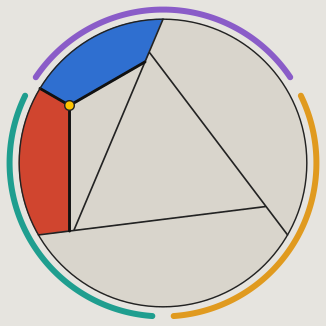
- 輻(や):弧に接し、しかも盤の中心となる場所(風車の形では中央の三角形)まで届く、確定した細い片のことです。誰にも切れない通り道になるので、とても強力です。最初の1手で輻を作ると、たいてい交代されます。
設計ノート:開始の形について
- はじめ、このゲームは円盤を3本の半径で3つの扇形に分けた形から始めていました。
- 遊び込むうちに、中心のすぐそばを、半径とほぼ平行に切る手が見つかりました。この手は、中心から弧まで半径を丸ごと覆う、確定した細い片を作ります。3つの扇形すべてが接する中心と弧を、誰にも切れない形で結ぶこの片を、「輻(や)」と呼ぶことにしました。
- 先手が最初の1手で輻を作ると、後手はほとんど受けられませんでした。交代を入れても、今度は先手が輻を作らなければ、後手が2手目で中心を切って勝てることが多く、先手と後手のどちらにとっても、勝負が序盤のごく狭い一手で決まってしまいました。これはゲームとしての欠陥でした。
- そこで、3本の線をずらして中央に正三角形を残す、今の風車の形に改めました。線が1点に集まらないので、1つの片で中心と弧を一気に結ぶことができなくなりました。輻に近い形は今も作れますが、弧から中央の三角形に届くだけなので、勝ちを決めるには何手もかかり、相手に受ける時間が残ります。
- 3つの扇形から始める形は、デモの設定で今も選べます。
Components
- One disk (the game is meant to be played on a computer). Its radius is 1, in coordinates with the centre at (0, 0).
Definitions
- Region: a part of the disk bounded by lines. Each region is neutral, Blue or Red.
- Part: each of the three pieces one cut makes. Every part becomes a new region.
- Settled region: a region that can no longer be cut so that all three parts reach the minimum area. Nobody can cut it, so its colour stays to the end of the game. A neutral region that becomes settled goes to the opponent at the end of the turn (see On Your Turn).
- Goal arcs: the three arcs A, B and C into which the rim is divided. Each arc boundary sits in the middle of the rim of one of the three outer regions.
- Grid: none. A cut may start at any point of the disk, with real-number coordinates.
- Direction step: none. Rays may point at any real-number angle (in degrees).
- Minimum area: 0.5% of the disk’s area. Areas are given as a percentage of the whole disk.
- In the demo you can change the starting shape (pinwheel or three sectors), the grid’s shape (square, triangular or none) and how fine it is (how many grid steps the disk’s diameter spans), the number of directions per turn (a divisor of 360 that is a multiple of 3, or real-number angles) and, with 3 or 6 directions, which direction they start from, and the minimum area (on or off, and its value). The values above are the standard settings.
End of the Game
- You win when a group of your own regions, joined by shared edges, touches all three arcs.
- Every move also hands regions to your opponent, so a move can complete your opponent’s connection instead; then your opponent wins. The two players can never both be connected at once.
Setup
- The disk starts divided by three lines into four neutral regions (the pinwheel). The lines run in from three points of the rim 120° apart (top, lower left, lower right) and end on one another, leaving an equilateral triangle in the middle.
- The central triangle and the three outer regions are each exactly a quarter of the disk. Each outer region touches two arcs; the triangle touches none.
- Choose your color. Blue moves first.
Swap (Pie Rule)
- After Blue’s first move, Red may choose to swap, once. The players trade colors; the board stays as it is, and Red (the player who made the first move) is to move.
- If Red does not swap, Red simply makes a move.
- So Blue avoids a first move that is too strong (it would be swapped) and looks for one that leaves it content either way.
On Your Turn
- Choose a neutral region or one of your opponent’s regions. You may not cut your own.
- From a point inside it, draw three rays 120° apart out to the region’s edge, splitting it into three parts. The point may be anywhere inside the region (but not on a line). With a grid or a direction step set, the point and the rays follow them.
- Cutting a neutral region: one part becomes yours, one becomes your opponent’s, and one stays neutral.
- Cutting an opponent’s region: one part becomes yours, and the other two stay theirs.
- A ray may not end on an existing vertex or on an arc boundary.
- Every part must be at least the minimum area.
- At the end of your turn, any neutral region that has become settled goes to your opponent.
Strategy Tips
- Settle your parts: a part smaller than three minimum areas (1.5%) can never be cut again. Settle your own part and your opponent cannot break into it. Strong players settle their own part on nearly every move.
- The part you give and the part you leave: every move hands your opponent a part. Make sure it does not help their connection, and that a part you leave neutral does not become settled and go to them.
- The central triangle: the only region that borders all three outer regions. It touches no arc, but many connections of both players run through it, and how it is cut, and by whom, often decides the game.
- Spokes: a thin settled part that touches an arc and reaches the hub of the board (with the pinwheel, the central triangle). It is a path nobody can cut, and very strong. A first move that makes a spoke is usually swapped.
Design Note: The Starting Shape
- At first the game started from three sectors, the disk cut by three radii.
- Played in depth, it turned up a move right next to the centre, almost parallel to a radius. It makes a thin settled part that covers a whole radius, from the centre to an arc, tying the centre (which all three sectors share) to that arc in a way nobody can cut. We called such a part a spoke.
- A first move making a spoke left the second player almost no defence. Even with the swap, if the first player made no spoke, the second player could often win by cutting at the centre on move two, so for both players the game was settled by one very precise early move. That was a flaw.
- So the start became today’s pinwheel: the three lines are shifted to leave an equilateral triangle in the middle. As the lines no longer meet at one point, one part can no longer tie the centre to an arc at a stroke. Something like a spoke can still be made, but it only reaches from an arc to the central triangle, so winning with it takes several moves and leaves the opponent time to answer.
- The three-sector start can still be chosen in the demo’s settings.