 Kashio Games
Kazura かずら/kɑˈzuːrə/
- 発表Year
- 2026
- 必要な道具You need
- 黒と白の石、縦横に13ずつ点が並んだ正方形のボード(13路の碁盤と碁石でも遊べます。9路や19路で遊んでもかまいません)Black and White stones; A square board of 13 × 13 points (a 13×13 Go board and stones work too; 9×9 and 19×19 boards can be used as well)
黒と白が交互に石を置き、自分のグループの中のいちばん長い道の長さを競うゲームです。自分の石でループを作ることはできないので、どのグループも枝分かれする木になります。
道は曲げるほど長くなりますが、詰めすぎると自分の石に触れて伸ばせなくなります。自分の道を伸ばしながら、相手の道の先をふさいでいきます。碁盤と碁石で遊べます。
Black and White take turns placing stones, and compete for the longest path through one of their groups. You may not close a loop of your own stones, so every group grows as a branching tree.
A path gets longer the more it bends, but packed too tightly it runs into your own stones and can grow no further. You extend your own paths while blocking the ends of your opponent’s. A Go board and stones are all you need.
ルールRules
コンポーネント
- 黒と白の石
- 縦横に13ずつ点が並んだ正方形のボード(13路の碁盤と碁石でも遊べます。9路や19路で遊んでもかまいません)
定義
- 隣接:縦か横に隣り合う点のことです。斜めは隣接に含みません。
- グループ:互いに隣接した同色の石の集まりのことです。他の石と隣接していない石も1つのグループとみなします。
- ループ:同じグループの石を、隣接する石へ順にたどって、同じ石を2度通らずに元の石へ戻れるつながりのことです。最も小さいループは、2×2に並んだ4つの石です。
- 道:グループの中で、隣接する石を順にたどった、同じ石を2度通らない並びのことです。グループにはループがないので、2つの石を結ぶ道は必ず1通りに決まります。
- 長さ:グループの中で最も長い道を作る石の数のことです。他の石と隣接していない石の長さは1です。
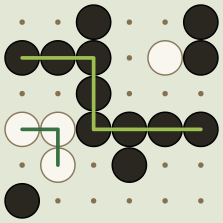
終了条件
- 2人とも置ける点がなくなった時点でゲーム終了となります。
- 終了時、お互いのグループの長さを長い順に並べて比較します。最初に長さが異なった時点で、より長いグループを持っていたプレイヤーの勝利となります。
- 途中で一方のグループが尽きた場合は、グループがまだ残っているプレイヤーの勝利となります。長さがすべて同じ場合は引き分けとなります。
- 途中で投了することもできます。投了したプレイヤーの負けとなります。一方のいちばん長いグループが、相手がこの先作れるどのグループよりも長くなったら、勝敗はもう変わらないので、投了するとよいでしょう。
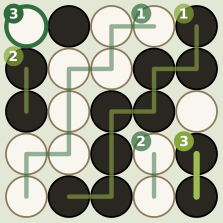
準備
- 盤面には何も置かず、空の状態で開始します。
- 自分の色を選択します。黒が先手番です。
交代(パイルール)
- 黒の最初の1手のあと、白は一度だけ交代を選べます。交代すると、2人が持つ色を入れ替えます。盤面はそのままで、白(最初の1手を置いたプレイヤー)の手番になります。
- 交代しない場合は、白はそのまま石を置きます。
- このルールのため、黒は「強すぎて交代されてしまう」最初の1手を避け、交代されてもされなくても困らない手を探すことになります。
手番
各プレイヤーは手番ごとに、以下を行います。
- 石の配置:盤上の空いている任意の点に、自分の色の石を1つ配置します。ただし、置ける点には以下の制限があります。
- 制限:自分の石でループを作る配置は禁止です。つまり、同じグループに属する自分の石の2つ以上と隣接する点には置けません。別々のグループの石と隣接する点には置けます(そのグループどうしはつながります)。
- 置ける点がない場合:手番を飛ばし、相手が続けて置きます。置ける点があるときは、必ず置かなければなりません。
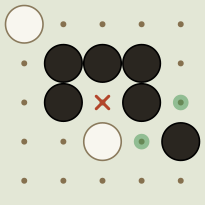
Components
- Black and White stones
- A square board of 13 × 13 points (a 13×13 Go board and stones work too; 9×9 and 19×19 boards can be used as well)
Definitions
- Adjacent: Two points next to each other across or down. Diagonal points are not adjacent.
- Group: A collection of adjacent stones of the same color. A single stone that is not adjacent to any other stone is also considered a group.
- Loop: A chain of stones of one group that you can follow from stone to adjacent stone, never visiting a stone twice, back to where you started. The smallest loop is four stones in a 2 × 2 square.
- Path: A sequence of stones of one group, each adjacent to the next, that visits no stone twice. Since a group has no loops, there is exactly one path between any two of its stones.
- Length: The number of stones on the longest path in a group. A stone adjacent to no other stone has length 1.
End of the Game
- The game ends when neither player can place a stone.
- Upon game end, list each player's group lengths from longest to shortest and compare them one by one. At the first point where the lengths differ, the player with the longer group wins.
- If one player runs out of groups first, the player who still has groups left wins. If all lengths are the same, the game is a draw.
- A player may also resign at any time, and loses. Once one player’s longest group is longer than any group the other can still make, the result can no longer change, and resigning is the natural thing to do.
Setup
- The board starts empty.
- Choose your color. Black plays first.
Swap (Pie Rule)
- After Black’s first move, White may choose to swap, once. The players trade colors; the board stays as it is, and White (the player who made the first move) is to move.
- If White does not swap, White simply places a stone.
- So Black avoids a first move that is too strong (it would be swapped) and looks for one that leaves it content either way.
On Your Turn
On your turn, do the following:
- PLACE A STONE: Place one stone of your color on any empty point, subject to the following restriction:
- Restriction: You may not make a placement that closes a loop of your own stones. That is, you may not place on a point adjacent to two or more of your stones that belong to the same group. You may place next to stones of different groups (those groups are then joined).
- NOWHERE TO PLACE: If you cannot place anywhere, your turn is skipped and your opponent places again. If you can place, you must.