 Kashio Games
NECTO ネクト/ˈnɛktoʊ/ 実験作Experimental
- 発表Year
- 2026
- 必要な道具You need
- コンピューターで遊ぶゲーム(盤と駒では遊びにくい)Played on a computer (hard to play with a physical board)
まず交互にタイルを置いて盤を線で埋め、次にタイルを1枚ずつ交差の少ないものへ置き直して、名前の付く結び目を作るゲームです。
結び目の点数は、最後に置き直した人ではなく、その輪の交差を多く置いた人に入ります。結び目かどうかの判定はコンピューターが行います。
Take turns laying tiles until the board is filled with loops, then replace tiles one at a time with tiles of fewer crossings to make named knots.
A knot scores not for whoever made the last replacement but for whoever placed more of its crossings. The computer works out which loops are knots.
結び目の判定をコンピューターに任せた実験的な作品です。遊び方やバランスは、まだ検証の途中です。An experimental work that leaves the knot theory to the computer. Its play and balance are still being explored.
ルールRules
コンポーネント
- 正方形のタイル 8種類(曲線2種・交差2種・ねじれ4種)。どのタイルにも、各辺の中央に線の端が1つずつあり、2本の線がそれらを2つずつつないでいます。交差のタイルには交差が1つ、ねじれのタイルには2つあります。
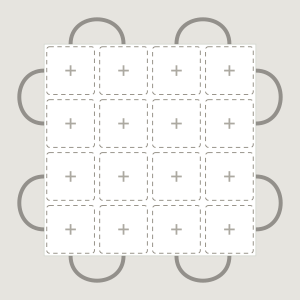
- 一辺が6マスの正方形の盤(4×4・8×8でも遊べます)。盤の周りには枠があり、外周に出ている線の端を、隣どうし2つずつつないでいます。

定義
- 輪:タイルと枠を通ってひとまわりし、元に戻ってくる1本の線のことです。盤が埋まると、すべての線が輪になります。
- 結び目:交差の上下を保ったまま、どう動かしても交差のない円にほどけない輪のことです。
- 名前の付く結び目と点数:交差が7つ以下で描ける結び目と、三葉結び目2つ(グラニー結び・本結び)、三葉結び目と8の字結び目の組み合わせです。点数は、その結び目を描くのに最低限必要な交差の数です(三葉結び目は3点、8の字結び目は4点、交差5の結び目は5点…交差7の結び目は7点、三葉結び目2つは6点、三葉結び目と8の字結び目は7点)。それより複雑な結び目は名前が付かず、得点になりません。
- 結び目かどうかと結び目の型は、コンピューターが判定します(アレクサンダー多項式による判定です。交差のとても多い輪では、まれに型を取り違えることがあります)。
- 輪の交差:輪が自分自身と交わっている交差のことです(別の輪との交差は数えません)。その交差があるタイルを置いた(置き直した)プレイヤーの交差として数えます。
終了条件
- 盤が埋まった後、手番のプレイヤーが置き直せるタイルがない(盤のタイルがすべて曲線になった)時点でゲーム終了となります。
- 合計点の多いプレイヤーの勝利となります。同点の場合は引き分けです。
準備
- 盤面には何も置かず、空の状態で開始します。
- 先手番と後手番を決めます。
手番
ゲームは、盤を埋める置く段階と、盤が埋まった後の置き直しの段階に分かれます。手番は2つの段階を通して交互に回ります。
- 置く段階(盤に空きマスがある間)
- 空いている任意のマスを1つ選び、8種類のうち好きなタイルを1枚置きます。この段階では得点は発生しません。
- 置き直しの段階(盤が埋まった後)
- 盤上のタイルを1枚選び、交差がより少ないタイルに置き換えます(ねじれ→交差か曲線、交差→曲線。向きは自由です)。置き換えたタイルは、置き直したプレイヤーのものになります。
- 置き直したマスを通る輪が、名前の付く結び目に新しくなったとき(置き直す前から同じ型だった場合は除きます)、その輪の点数がその輪の交差を多く置いたプレイヤーに入ります。交差の数が同じ場合は、両方のプレイヤーが得点します。
- 得点は、その後に輪の形が変わっても消えません。


Components
- Square tiles of 8 kinds (2 curves, 2 crosses, 4 twists). Every tile has a line end at the middle of each side, and two strands join them in pairs. A cross tile holds one crossing and a twist tile two.
- A square board of 6 × 6 cells (4 × 4 and 8 × 8 also work). A frame around the board joins the line ends on its edge, two neighbouring ends at a time.
Definitions
- Loop: a line that runs through tiles and the frame and comes back to where it started. When the board is full, every line is a loop.
- Knot: a loop that cannot be untangled into a circle without crossings, however it is moved, as long as each crossing keeps which strand is on top.
- Named knots and their values: the knots that can be drawn with at most 7 crossings, plus two trefoils (granny or square knot) and a trefoil with a figure-eight knot. A named knot is worth the fewest crossings any drawing of it needs (trefoil 3, figure-eight knot 4, knots of 5 crossings 5, … knots of 7 crossings 7, two trefoils 6, trefoil with figure-eight 7). More complex knots have no name and score nothing.
- The computer decides whether a loop is knotted and which knot it is (from its Alexander polynomial; on loops with very many crossings it may, rarely, mistake the type).
- A loop’s crossings: the crossings where the loop crosses itself (crossings with other loops do not count). Each crossing belongs to the player who placed (or replaced) its tile.
End of the Game
- Once the board is full, the game ends when the player to move has no tile to replace (every tile on the board is a curve).
- The player with the higher total wins. Equal totals are a draw.
Setup
- The board starts empty.
- Decide who plays first.
On Your Turn
The game has two stages: placing, until the board is full, and then replacing. Turns alternate throughout.
- Placing (while the board has empty cells)
- Choose any empty cell and place any one of the 8 tiles on it. Nobody scores in this stage.
- Replacing (once the board is full)
- Choose a tile on the board and replace it with a tile that has fewer crossings (twist → cross or curve, cross → curve; any orientation). The new tile belongs to the player who placed it.
- When a loop through the replaced cell becomes a named knot (one it was not already before the replacement), its value goes to the player who placed more of that loop’s crossings. If both placed the same number, both players score it.
- Points stay even if the loop changes later.